Disclosure: This post contains affiliate links. If you buy through them, we may earn a commission at no extra cost to you. As an Amazon Associate I earn from qualifying purchases.
I’m writing this while Nori, my silver-gray kitten, does a lap around the living room and then just… stops. Mid-run. Flops over like the batteries died. He’s five and a half months old now, and I still don’t fully trust that he’s going to be okay, which I’m starting to think is just what having a kitten feels like. Everyone tells you kittens are cute, and then you bring one home and spend the first two months wondering if you’re doing literally everything wrong. So this is the guide I wish I’d had, written by someone who did it badly first.
I picked Nori up from a neighbor whose cat had a surprise litter. He was eight weeks, supposedly — I say supposedly because I now suspect he was closer to six, which explains a lot of what happened next.
The woman handed him to me in a cardboard box with holes poked in it, and I remember thinking, this is a very small animal, and I am allowed to just take him home. He didn’t make a sound the whole drive. I thought that was a good sign. It was not a good sign. It was him being terrified and shut down, but I didn’t know that yet.
The first night he hid under the couch for five hours — five hours of not existing as far as I could tell. I lay on the floor with my face pressed to the carpet, reading every article about kittens hiding, and they all said the same thing: give him space, he’ll come out when he’s ready. Okay. Great. But no article mentioned that you’d feel like a kidnapper the entire time.
When he finally came out, around midnight, he was so hungry he was almost vibrating. And that’s where the real trouble started: the feeding.
Here’s the thing about the whole “eight weeks and ready for solid food” idea: it’s sort of true and sort of not. Nori was technically eating kibble when I got him, but barely. He’d sniff it, maybe crunch two pieces, and walk away. I’d read all these kitten feeding charts — I had like four tabs open — and they all said “feed 3-4 times a day, offer wet food, keep fresh water out,” which is fine advice, except nobody explained that a kitten that’s actually still semi-weaned will pretend to eat solids and then just slowly starve in front of you.
That first week I did what I think a lot of new owners do: I panicked, and tried to fix it by offering more options. I bought three brands of wet food and two of kibble, put down bowls of everything, rotated them like I was running a tasting menu. Nori would lick the gravy off one and refuse the rest. I was cleaning up more food than he was eating, and I was genuinely scared, because he was so tiny and I could feel his ribs.
I remember sitting on the kitchen floor at 2am, holding a spoonful of wet food in front of his face, and he just turned his head away like I was offering him poison. I almost cried. I think I actually did cry a little. It looks so stupid in hindsight — a giant human negotiating with a half-pound creature over a spoon — but in the moment it’s devastating.
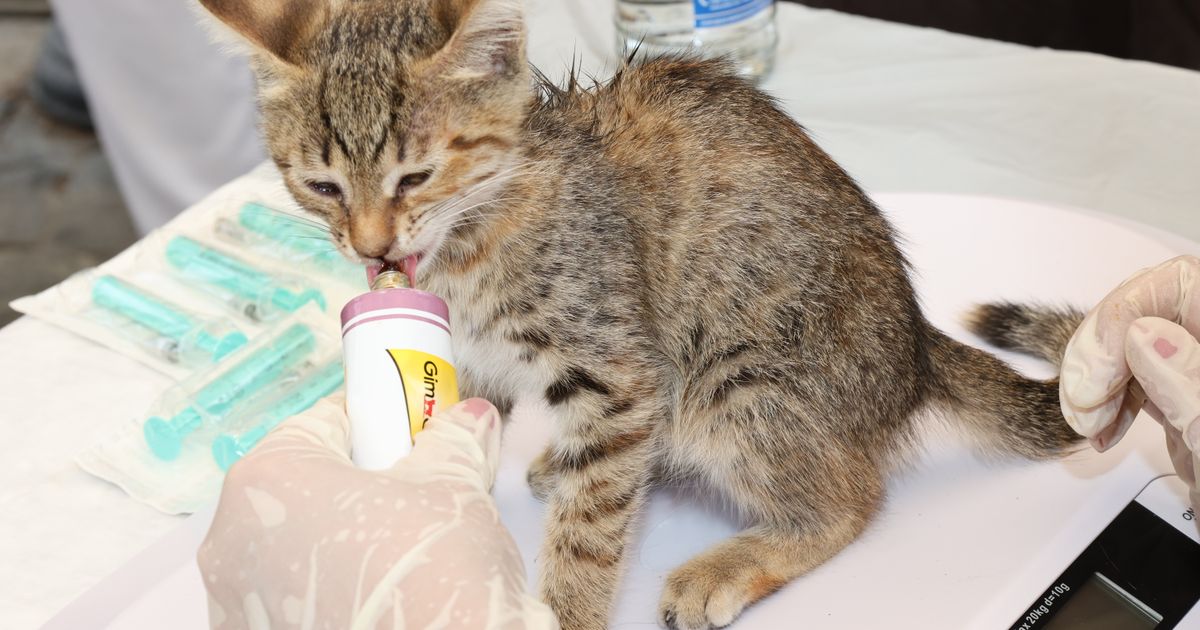
The thing that actually saved us was a comment I saw somewhere online. I don’t even remember what platform. I was deep in a rabbit hole of “kitten won’t eat” posts, and this one person — let me paraphrase because I can’t remember the exact wording — said their kitten had the same problem, refusing every food, and what finally worked was feeding with a syringe. Not the needle kind, obviously. Like a plastic medicine syringe, the kind you’d use for a baby’s liquid meds. They warmed up some kitten milk replacer and squirted it slowly into the side of the kitten’s mouth, a little at a time, until the kitten got the idea that eating was safe and started actually wanting food.
I ordered a pack of syringes on Amazon that same night. I’m not even joking. Best five dollars I’ve ever spent.
The trick, and this is important, is to go slow. You put the tip in the corner of the mouth, not straight back into the throat — straight back is how you accidentally get milk in their lungs, which I read about and then spent an hour being terrified of. You squeeze out maybe half a milliliter, wait for them to swallow, do it again. Nori was confused for about ten seconds and then it clicked: oh, this is food, this is good. After a couple of feedings that way, he started walking toward the bowl on his own and eating properly. Something about the syringe just… unblocked him. I don’t know. I’m not a vet. I’m a guy who fed his kitten with a syringe for two days and it worked.
Also, full disclosure: I mixed the milk replacer with a little goat’s milk, because I’d read that some kittens take to it better and it’s easier on their stomachs. I’m not sure if that made the difference or if it was just the syringe — no study here, sorry — but it worked for us, so I’m putting it out there the same way that comment put it out there for me.
And honestly, thinking back, I don’t even know why that random comment was the thing that finally got through to me. By then I’d read forty articles that all ended with “consult your vet,” and I was desperate for someone to just tell me what to do. Also the neighbor kept texting “is he eating?” and I kept typing back “sort of,” which was not the answer either of us wanted.
The weaning part, if I’m honest, is where I was most clueless, and it’s the part I’d want to explain to someone in my old shoes. It’s not an event, it’s a slow messy process that can go backwards. One day Nori would eat wet food like a champ, the next day he’d refuse everything and I’d panic all over again. Kittens don’t wean on a schedule. He weaned when he was ready, and sometimes he’d regress for a day or two, especially when he was tired or stressed or his teeth hurt. In those earliest weeks — which I now realize were really weeks 6-8 for him — the food needed to be soft and stinky. Kitten wet food, pâté style, warmed up slightly so it smells more. If he wouldn’t eat from the bowl, I’d put a tiny smear on my finger and let him lick it. That worked more often than it didn’t, and honestly it was kind of bonding, gross as it sounds. Weeks 8-10 was when he started actually eating meals instead of snacks. I’d feed him four times a day, small portions, because their stomachs are tiny and they burn through everything. I kept a little chart on my phone of how much he ate, which sounds insane but actually helped me notice when something was off.
Around 10 weeks to 3 months, he got way more confident with food, which is when I learned the second big lesson: kittens need kitten food, not adult food, and they need it until they’re about a year old. I almost switched him to regular adult kibble at like 12 weeks because I wasn’t paying attention and grabbed the wrong bag at the store, and then I read that kittens need way more protein and fat and specific nutrients like taurine for their development. So, yeah. Kitten food. Until twelve months. Got it.
And by 4-6 months, which is where we are now, he eats like a small garbage disposal. Three meals a day plus the occasional treat, and he still acts like he’s starving at 7am. The thing nobody tells you is that their growth spurts are not linear. There were weeks where he ate twice as much, and weeks where he barely touched food, and both were completely fine. I nearly had a meltdown during a slow week, took him to the vet, and the vet was basically like “he’s fine, he’s just between growth spurts, stop weighing him so much.”
Which brings me to the weighing thing, because I definitely messed that up too. I bought a kitchen scale. Not for cooking. For the kitten.
I weighed Nori every single morning for about three weeks and plotted it in a notes app like I was tracking a stock. Up and to the right, good. Flat for two days, panic. Down a little, absolute crisis. Daily weighing is a great way to drive yourself crazy, is what I learned. Kittens gain weight in fits and starts — a hundred grams, hold steady, then jump again. And honestly, a kitten that’s playing, that’s eating at least reasonably, that’s using the litter box and has energy — that kitten is probably fine, and I had to learn that the slow way. The vet told me they should gain around 100 grams a week in the early months, but that’s an average, not a law. Some kittens are just smaller. Nori is about 2.6 kilos at five and a half months, a little under average for his age, and the vet is not worried at all. I’m choosing to trust that.
And if you’re worried about weight, the first thing to check isn’t the scale, it’s the litter box. Eating, playing, pooping normally? Probably fine. Stops eating for more than a day, gets lethargic, or diarrhea that won’t quit? That’s when you should call the vet instead of keep googling. I once stayed up until 3am googling whether a kitten’s poop was “too soft” and got absolutely nowhere.
While I’m confessing, there were other mistakes too. I let him chew on my fingers way too much, because it was cute, and now he’s at the age where his adult teeth are coming in and “cute” is the last word I’d use. I’ve got the scars, figuratively. Use toys for wrestling, not hands. I knew this. I did it anyway, and now I’m paying for it.
I also made the classic mistake of picking him up constantly, especially when he was tiny, because I couldn’t believe I had a real cat. He tolerated it when he was little, but around four months he started squirming away, and I took it personally for a week before I realized he just needed space sometimes. I’d read the article about letting the kitten initiate cuddles and I nodded along, and then I did the exact opposite, because he was so soft.
Oh, and the classic one: I bought a ridiculous amount of stuff before he came home — toys, beds, a fountain, three kinds of litter — and it turned out he only cares about the cardboard box the fountain came in and a crumpled receipt. He’s currently sleeping in the box, by the way. The expensive bed is untouched. This is how it goes.
If I could go back and tell myself one thing, it wouldn’t be about food amounts or schedules. It would be: relax, the kitten is more resilient than you think, and the fact that you’re worried is exactly why you’re probably going to be fine. I know that sounds like a fortune cookie, but I mean it in the most practical way possible. I spent so much energy being scared that I missed some of the fun of those early weeks. I’d also tell myself to take more videos. Not photos — videos. The way kittens move changes so fast. I have maybe three videos of Nori as a tiny kitten and I’d give a lot for more.
And I’d tell myself that the 5am wake-up screaming phase passes. It does. It’s brutal while it’s happening — there were mornings I genuinely considered whether cats were a mistake — but they grow out of it, especially once you stop rewarding it by getting up and feeding them at 5am. I didn’t stop rewarding it for a long time, by the way. I was tired. Don’t judge me.
Nori is five and a half months old, healthy, ridiculous, and currently attacking my shoelace as I type this. He still does the 3am zoomies sometimes. He still eats like he’s never been fed, which I’m told is just his personality. He still doesn’t like being held for long, and I’ve mostly made peace with that — mostly.
If your kitten is refusing food, or you’re in that first week of panic, do the syringe trick. Warm the milk replacer, go slow, be patient. It genuinely turned things around for us in a single evening. And if your kitten is eating and playing and pooping and growing, even in fits and starts, you’re probably doing fine. I know “probably” isn’t a satisfying answer, but it’s the honest one, and honestly, it’s the one I needed to hear back in May. The Cornell Feline Health Center and the ASPCA both have free, detailed pages on kitten nutrition if you want something more official than me — I checked about a hundred times.
Anyway. He just woke up and is trying to eat my phone cord. I think that means we’re good. You’ll be fine too — you clearly care enough to be reading this at 1am, and that’s honestly half the battle. Go feed the little monster.
Reminder: This post contains affiliate links. See our full disclosure here.
Love cats? Get more tips like this
Join our newsletter for practical cat care guides, honest product roundups, and new posts delivered straight to your inbox. No spam — unsubscribe anytime.