Disclosure: This post contains affiliate links. If you buy through them, we may earn a commission at no extra cost to you. As an Amazon Associate I earn from qualifying purchases.
My apartment is 680 square feet. My cat Tofu is eight months old, roughly five pounds of pure chaos, and he has decided that the top of the bookshelf is his throne. The problem isn’t that he climbs. The problem is that the bookshelf was not designed for a cat who treats gravity as a suggestion, and I’ve watched it wobble one too many times.
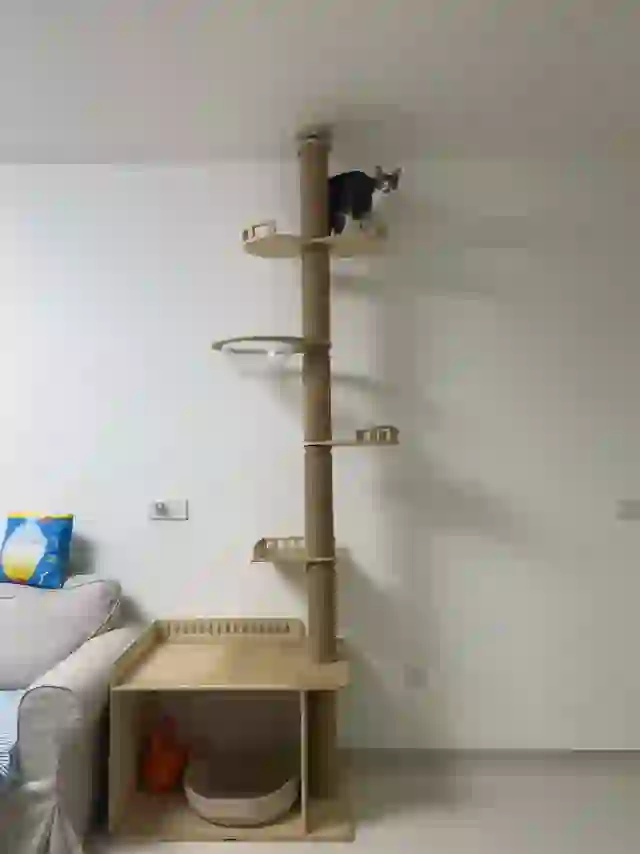
That’s how I ended up researching cat trees for small spaces. Not the six-foot cat condos you see in suburban living rooms — those would take up half my apartment. I needed something that gives a cat vertical territory without turning my living room into a jungle gym showroom.
Here’s what I learned, and the three I actually tested.
The thing about “small apartment” cat trees
You’d think a small cat tree is just a big one with fewer platforms. It’s not. When space is tight, three things matter way more:
- Footprint. A wide base you don’t have, a tall and narrow silhouette you might. I measured mine before I bought it — base width, platform depth, ceiling height above the spot — and it saved me from buying a tree that would have blocked the hallway. Measure the floor and the ceiling, not just the box dimensions.
- Stability. This is non-negotiable, because a wobbly tree is a tree your cat will refuse to use — and a tree that tips is a tree that injures someone. The general rule of thumb: the tree should be heavier than your cat, and the base should be wider than the tallest platform’s reach. If you can rock it with one hand, your cat can tip it with one launch.
- Height. Cats want to be high. If your tree tops out at waist level, your cat will treat it as a stepping stone and keep climbing your actual furniture. In a small apartment, height is free real estate — it uses the air you weren’t using anyway.
The other thing I learned: a cat tree you buy and your cat never touches is just an expensive coat rack. Placement matters more than almost everything else. Put it near a window, in a spot your cat already claims, and it’ll get used. Put it in the corner “where it looks nice,” and you’ll be dusting it for a year.
One more consideration people skip: how the tree sounds. Trees with lots of hanging toys and bells sound like a wind chime every time your cat moves, which is charming for exactly one night. If your cat is active at 4 a.m. — and all kittens are — buy the quieter version or remove the toys before bed.
FEANDREA: the one that actually earned its spot
Price: around $70-120 depending on size.
I bought a mid-size FEANDREA with three platforms and a sisal-wrapped post. Assembly took about 25 minutes, which felt annoying at the time and has been worth it since. The instructions are the standard hieroglyphic booklet, but the parts are labeled well enough that you can mostly figure it out by looking at the picture. Keep the hex key — you’ll need it again, and not just for the initial build.
The construction is solid for the price. It doesn’t wobble when Tofu launches himself onto the top platform, which is honestly the highest praise I can give any cat furniture. The sisal post is getting genuinely scratched — that’s the sign it’s being used — and the fleece platforms vacuum clean without drama. The fleece also holds up better than the carpet-covered platforms on cheaper trees, which matters when your cat has decided the top platform is his bed.
One warning: the screws on the base need to be tightened again after a few weeks. I found this out when the whole thing developed a slight lean and I ignored it until it started rocking. Tightened everything back up, fine since. If you buy this one, keep the hex key that comes in the box. You’ll need it again. It’s the only maintenance this tree has asked for in over a year, which is better than I can say for most furniture I own.
For sizing: the mid-size works for a single cat or two small cats in a compact room. If you have a 15-pound Maine Coon or a pair of rowdy teenagers, step up to the larger version — the platforms are wider and the post is thicker, and the price difference is smaller than the vet bill for a tipped tree.
Yaheetech: the budget option that’s better than it should be
Price: around $50-100.
Yaheetech makes a bunch of sizes, and the small-to-medium ones are aggressively cheap. I grabbed one for my office (yes, I have two cat trees now — no, I don’t want to talk about it) to give Tofu a perch while I work.
The quality is genuinely fine for the price. The base is a little smaller than the FEANDREA’s, so it needs to be against a wall, and I wouldn’t trust it with a 15-pound cat launching from the top. But for a 5-8 pound cat in a small room, it does the job. I also appreciate that the smaller sizes are light enough to move when you’re figuring out where your cat actually wants to climb — I relocated mine twice before Tofu settled on the window-side spot.
The weak point is the carpet-covered platform. Cats love carpet for scratching, which sounds good until you realize the platform carpet gets shredded while your actual scratching post stays pristine. It’s a “replace the tree every couple years” kind of product, not a “pass it down to your grandchildren” one. The carpet also traps fur in a way that fleece doesn’t — you’ll be picking little fibers out of it with a lint roller every few weeks, and eventually you’ll stop caring, and that’s fine too.
If you’re on a tight budget, this is the one to get, with two caveats: anchor it against a wall, and don’t expect the platform carpet to look good for more than a year. Both are acceptable trade-offs at this price.
Go Pet Club: the one I almost returned
Price: around $40-80.
I wanted to like Go Pet Club because the price is the lowest of the three. And for kittens or very small cats, it’s honestly okay. The platforms are decent, and the tree is lightweight enough to move around the apartment, which is a genuine plus when you’re testing where your cat actually likes to climb.
But “lightweight” is also the problem. Mine wobbled noticeably with Tofu at five pounds, and I wouldn’t trust it with anything heavier. The base is thin, the materials are visibly cheaper, and after two months the sisal was already fraying in a way that felt premature. It’s fine as a starter tree. It’s not a long-term solution. I’d frame it as “the tree you buy to learn what your cat likes,” not “the tree you buy to keep.”
For a kitten under six months, though, it’s actually a reasonable first purchase: kittens grow fast, their preferences change, and by the time this tree falls apart, you’ll know exactly what size and style to buy next. Consider the cheap tree an education expense.
Reading the spec sheet like you mean it
The marketing photos on cat tree listings are worse than useless — every tree looks tall, stable, and beloved in the picture. Here’s how to read the actual numbers:
- Height: measure your ceiling before you fall in love with a 6-foot tree. You want the top platform about a foot below the ceiling — close enough to feel high, far enough that your cat doesn’t bonk their head. I measured my apartment wrong once (assumed 8-foot ceilings, actually 7’6″) and ended up with a tree that barely fit. Measure first.
- Base width: the single most important stability number. A tree with a 15-inch square base and a 40-inch height is a physics problem. The rule I use: base diameter should be at least 60% of the tree’s height, and the tree should weigh more than your cat. If the listing doesn’t show the base dimensions, find one that does.
- Platform size: your cat needs to turn around on the top platform, not just perch on it. A 12-inch round platform is fine for a 7-pound cat; a Maine Coon needs 16 inches minimum, and honestly more. Check the weight limit too — most trees list a per-platform weight, and cats don’t read it.
- Sisal quality: this is where cheap trees quietly fail. Real sisal rope lasts; the thin synthetic stuff frays within months and then your couch is back on the menu. Look for dense, tight-wound sisal on the main posts, and plan to replace it eventually — sisal wrapping is the first thing to wear out on any tree, and there’s no shame in re-wrapping a post.
- Post thickness: a skinny post wobbles and flexes when a cat launches past it. You want a post thick enough that you can’t bend it with both hands. This sounds obvious, but it’s the exact spec that budget trees cut corners on.
And a note on assembly: allocate half an hour and don’t tighten everything fully until the whole frame is up. I learned this the angry way — tightened the base first, then discovered the top platform bolt was misaligned and had to loosen half the tree to fix it. Assemble loosely, align everything, then tighten.
The comparison
| FEANDREA | Yaheetech | Go Pet Club | |
|---|---|---|---|
| Price | $70-120 | $50-100 | $40-80 |
| Stability | Solid | Needs a wall | Wobbly |
| Best for | Most cats | Small cats, tight budgets | Kittens, temporary setups |
| Assembly | Moderate | Easy | Easy |
| Longevity | Years | 1-2 years | Less |
Making any cat tree work in a small space
A few things that made the difference between “cat tree as decoration” and “cat tree as daily headquarters”:
- Put it by a window. Tofu uses his tree about ten times more now that he can watch birds while perched on it. Sunlight + a view = cat magnet. If your window is cold in winter, add a pad — cats will abandon a great tree for a warm one.
- Give it a reason to exist near your furniture. If your cat scratches the couch arm, put the tree’s sisal post right next to that couch arm. They’ll choose the tree eventually, especially if you redirect them every time. The rule is: make the good behavior easier than the bad behavior.
- Add a little variety. My cats ignore any toy that sits in the same spot for more than a week, and the tree is no different — I rotate a dangling toy on the top platform and it resets their interest.
- Consider a window perch as a bonus. Cats who love heights love window spots even more — window perches give them the high ground with a view, without taking up floor space.
- If your cat is a senior or has mobility issues, choose a tree with low step spacing. I added a step to mine for Sam, my 15-year-old, and he uses the bottom platform like a bench — which is more than he used any tree before.
- Anchor the tree if you have a very active cat. Some models have a wall-anchoring kit, and it’s not overkill — a 12-pound cat hitting full speed can tip a tree that felt “solid” during your one-handed wobble test.
Bottom line
For a small apartment, my honest pick is the FEANDREA mid-size. It’s stable, it’s tall enough to satisfy a climber, and it doesn’t dominate the room. If the budget is tight, the Yaheetech is a respectable plan B — just keep it against a wall.
And if your cat still won’t use the tree after a week? Move it. I can’t stress this enough. The tree I originally put in the bedroom corner went unused for a month, then I dragged it to the living room window and it became Tofu’s favorite place in the apartment within a day. Cats have opinions. You just have to find where they parked them.
My bookshelf, by the way, is finally safe. Mostly. He still looks at it sometimes.
Prices and availability are accurate as of the publication date and may change. Please check the product page for current pricing.
Reminder: This post contains affiliate links. See our full disclosure here.
Love cats? Get more tips like this
Join our newsletter for practical cat care guides, honest product roundups, and new posts delivered straight to your inbox. No spam — unsubscribe anytime.